

Home > Support > Technical info > Types of Valves
Master 15+ Types of Valves: Functions, Industrial Uses, and More
Ever confused about how many types of valves exist? Learn the types of valves in piping and other systems, their classifications, and how they optimize fluid control effectively. Let’s go!
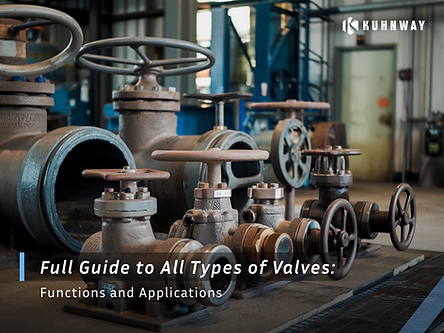
What is a Valve? What is Its Function?
A valve is a mechanical device used to regulate, direct, or stop the flow of fluids such as liquids, gases, or slurries within a piping system. It controls movement by opening, closing, or partially blocking a passageway inside the system.
In practical terms, valves are essential for system control and safety. They start or stop fluid flow when required. They regulate pressure to maintain balance and stable operation. They direct fluids into specific pathways within a network. They prevent backflow that could damage pumps or disrupt processes.
Valves also throttle flow rates to match operational demands, relieve excess pressure to protect equipment, isolate sections for maintenance, and fine-tune flow in sensitive applications. From household plumbing to complex industrial facilities, valves ensure efficiency, safety, and reliability.
-
Common Classifications for Valves
Because valves serve different purposes, they are classified in several ways. One of the most practical approaches is based on mechanical motion. Under this framework, valves fall into two main categories: linear motion and rotary motion.
-
Linear motion valves regulate flow by moving a closure element in a straight line. This element may be a gate, plug, diaphragm, or needle. The straight-line movement allows gradual adjustment, which makes these valves suitable for applications that require precise flow control and tight shut-off. Gate valves, globe valves, diaphragm valves, and needle valves are common examples.
-
Rotary motion valves operate using a rotating component such as a ball, disc, or plug. Most of them require only a 90-degree turn to move from fully open to fully closed. This quick action makes rotary valves ideal for systems that demand fast response and simple operation. Ball valves, butterfly valves, and plug valves are typical rotary designs.
-
Another way you may see valves described is by the number of turns needed for operation.
-
Multi-turn valves require several rotations of a handwheel or actuator to open or close gradually. These are commonly linear valves used where controlled sealing and precise adjustment are important.
-
Quarter-turn valves require only a single 90-degree rotation, which enables faster actuation and easier open and close control. These are usually rotary valves.
Valves can also be classified by their operating mode. Some valves are designed to operate automatically without external power. These are known as self-actuated or automatic valves. They respond directly to fluid conditions such as pressure, flow rate, or temperature. Because they do not require electricity or compressed air, they are cost-effective and relatively low-maintenance.
On the other hand, actuated valves rely on external mechanisms to operate. These may be electric motors, pneumatic actuators, or hydraulic systems. Actuated valves are commonly used in automated processes where speed, precision, remote control, and system integration are essential. They are ideal for industrial plants, control systems, and applications that demand consistent and reliable performance.
In the following sections, we will first explore the common types of linear and rotary motion valves in detail. We have also covered automatic and actuated valves as an important operational classification, and we will reference them where relevant as we move forward.
Different Types of Valves and Their Applications

-
Gate Valve
Gate valves are linear motion valves that use a flat or wedge-shaped gate to control fluid flow. Imagine a sliding door. When the gate lifts fully, fluid passes through with almost no obstruction. When it lowers, the flow is completely blocked. Because the gate moves entirely out of the flow path when open, the valve provides a straight-through design with minimal pressure loss. This makes gate valves highly efficient for systems that require smooth, unrestricted flow.
There are two common stem designs: rising stem and non-rising stem. A rising stem visibly moves upward when the valve opens, making it easy to identify the valve position. A non-rising stem remains stationary, which is useful in underground or tight installations. Gate valves are multi-turn devices and operate more slowly than quarter-turn valves. They are designed for full open or full close service and are not suitable for throttling, as partial opening can cause vibration and seat damage over time.
Gate valves are widely used in water distribution, oil and gas pipelines, steam systems, and industrial plants. They handle water, fuel, gas, steam, and some slurries effectively. Their strong sealing ability, durability, and relatively simple maintenance make them a reliable choice for isolation applications where tight shut-off and low pressure drop are essential.

-
Globe Valve
Globe valves are linear motion valves designed for regulating flow. They use a movable disk that travels up and down against a stationary seat inside a typically spherical body. You can compare it to adjusting a faucet. As the disk lowers, the flow decreases. As it rises, the flow increases. The internal S-shaped flow path forces fluid to change direction, which allows precise throttling and stable flow control, especially in systems that require accuracy.
Globe valves are multi-turn valves, meaning several rotations are needed to fully open or close them. They are well known for excellent throttling capability and reliable shut-off performance. Variations include straight-pattern, angle-pattern, and Y-pattern globe valves, each designed for different piping layouts. However, the curved flow path creates a higher pressure drop compared to gate valves. They are also heavier and more complex in construction, which can increase cost.
Globe valves are widely used in steam systems, cooling water lines, fuel handling, and process control applications where frequent adjustments are required. Their ability to maintain accurate flow regulation makes them valuable in power plants and industrial facilities. However, they are not ideal for fluids containing solid particles, as debris can damage the seat or cause clogging.

-
Needle Valve
Needle valves are linear motion valves built for extremely precise flow control. They operate using a long, tapered, needle-like plunger that moves into a small seat opening. As the stem turns, the needle gradually advances or retracts, adjusting the flow in very small increments. This fine-threaded mechanism allows accurate and stable regulation, making it ideal when even slight flow changes matter.
Needle valves are multi-turn valves, requiring several rotations to fully open or close. The narrow flow path provides excellent control but limits overall flow capacity. Because of this small orifice design, they are not suitable for high-flow applications. However, they can handle relatively high pressures in compact systems. Their tight sealing and fine adjustment capability make them a preferred option in precision-controlled environments.
Needle valves are commonly used in instrumentation systems, pressure gauges, chemical dosing lines, fuel control systems, and laboratory setups. They are especially valuable in industries where accurate metering and stable flow rates are critical. While not designed for large-volume transport, their durability, reliability, and ability to provide micro-adjustments make them indispensable in precision applications.

-
Pinch Valve
Pinch valves are linear motion valves that control flow by compressing a flexible rubber or elastomer sleeve. Imagine squeezing a garden hose to stop water. When the valve closes, a mechanical or pneumatic mechanism pinches the sleeve shut. When it opens, the sleeve returns to its original shape, allowing flow. Since the fluid only contacts the inner sleeve, the valve body and mechanical parts remain protected from corrosion and wear.
Pinch valves have a simple construction with very few moving parts. They can be manually operated or pneumatically actuated. Their straight-through design creates minimal turbulence and allows full-bore flow when open. They are particularly effective for handling abrasive slurries, viscous fluids, and media containing suspended solids. However, sleeve material selection is critical. The elastomer must be compatible with the fluid’s temperature, chemical properties, and pressure conditions. Sleeves may require periodic replacement due to wear.
These valves are widely used in mining, wastewater treatment, chemical processing, and food production. They are excellent for isolating aggressive or particle-laden media. However, they are not typically suitable for high-pressure gas service or extreme temperatures, as the sleeve may deform.
-
Diaphragm Valve
Diaphragm valves, also known as membrane valves, are linear motion valves that control flow by pressing a flexible diaphragm against a seat. When the stem moves downward, the diaphragm seals tightly against the body, stopping flow.
When lifted, fluid passes through. Because the fluid only contacts the valve body and diaphragm, internal mechanical parts remain isolated, reducing contamination and corrosion risks. Designs typically include weir-type and straight-through configurations, depending on flow requirements.
Diaphragm valves can be manually operated or actuated using pneumatic or electric systems. The flexible diaphragm is usually made from elastomers such as EPDM, PTFE, or other chemically resistant materials.
They provide excellent sealing performance and are well-suited for handling corrosive fluids, slurries, and media containing suspended solids. However, diaphragm materials can wear over time, especially under high pressure or elevated temperatures, which limits their use in extreme conditions.
These valves are widely used in water treatment, chemical processing, pharmaceutical manufacturing, and food and beverage production. Their smooth internal surfaces and minimal dead space make them ideal for hygienic and clean-in-place systems.

-
Ball Valve
Ball valves are rotary motion valves that use a spherical ball with a drilled bore through its center. When the handle or actuator turns 90 degrees, the bore aligns with the pipeline to allow flow. Rotating it perpendicular to the blocks blocks the passage. This quarter-turn design enables fast shut-off and tight sealing. Because the sealing surfaces press firmly against the ball, leakage is minimal, even under high pressure.
Ball valves are commonly available in floating and trunnion-mounted designs. In floating types, the ball is held in place by seats and shifts slightly to enhance sealing. Trunnion-mounted balls are mechanically supported, making them suitable for larger diameters and higher pressures.
They are also classified as full-bore or reduced-bore. Full-bore valves have an internal diameter that matches the pipe, minimizing pressure drop and allowing smooth, unrestricted flow. Reduced-bore valves have a smaller opening, which may create slight flow resistance but reduces size and cost.
Ball valves are widely used in oil and gas pipelines, hydraulic systems, chemical processing, and water distribution. Their quick operation, durability, and strong shut-off capability make them ideal for on/off service. However, they are not recommended for continuous throttling, as partial openings can cause seat wear and erosion.

-
Butterfly Valve
Butterfly valves are rotary motion valves that use a circular disc mounted on a shaft to control flow. When the handle or actuator turns 90 degrees, the disc rotates either parallel or perpendicular to the flow. In the fully open position, fluid passes around the thin disc. When closed, the disc blocks the passage. This simple quarter-turn mechanism allows fast and efficient operation, making butterfly valves ideal for systems that require quick shut-off.
Common body designs include wafer, lug, and double-flanged types, allowing installation flexibility. Butterfly valves are lightweight and compact compared to gate or globe valves, especially in large diameters. They offer relatively low pressure drop and are cost-effective for wide pipelines. However, because the disc remains in the flow path even when open, slight resistance is unavoidable. Throttling performance is acceptable at low pressure differentials, but high-pressure drops may affect stability and control accuracy.
Butterfly valves are widely used in water distribution, HVAC systems, fire protection, compressed air lines, and certain gas applications. They are especially suitable for large-diameter, low to medium-pressure systems. Although cleaning and maintenance can sometimes be more involved due to disc positioning, their quick actuation and space-saving design make them a popular solution across many industries.

-
Plug Valve
Plug valves are rotary motion valves that use a cylindrical or tapered plug with a bore drilled through it. When the plug rotates 90 degrees, the bore aligns with the pipeline to allow flow. Turn it again, and the solid portion blocks the passage. You can imagine twisting a cork to open or seal a bottle. The simple quarter-turn design enables quick shut-off and dependable isolation.
Plug valves are available in lubricated and non-lubricated designs. Lubricated types use a sealant injected between the plug and body to reduce friction and improve sealing. Non-lubricated or sleeved plug valves use PTFE or elastomer sleeves to minimize maintenance. Their straight-through flow path and wiping action help prevent particle buildup, making them suitable for slurries and fluids with suspended solids. However, larger plug valves may require higher operating torque, especially under high pressure.
Plug valves are widely used in chemical processing, oil and gas pipelines, refineries, sewage treatment, and mining operations. They perform well in systems handling gases, hydrocarbons, and abrasive media. While they offer fast, reliable on/off service, regular inspection and maintenance are important to ensure smooth operation.

Let’s look at some examples of automatic and actuated valves:
-
Check/non-return Valve
Check valves, also known as non-return valves, are automatic valves that permit fluid flow in one direction and prevent backflow. They operate with movable elements, such as a lift, tilting disk, or swing arm, which open when fluid flows forward and close automatically when the flow reverses. This simplicity ensures system protection without manual intervention by stems or handles.
However, they may not seal perfectly under low pressure or with debris. The risk of water hammer or pressure surges that could harm pipelines is another concern. Check valves are commonly used in pump discharge lines, water systems, fuel and oxidizer mixing systems, and gas pipelines to safeguard equipment and maintain process integrity.

-
Pressure-reducing Valve
Pressure-reducing valves are automatic valves designed to lower high inlet pressures to a stable, lower outlet pressure. They maintain consistent downstream pressure, even with upstream fluctuations. These valves are essential in protecting equipment, improving safety, and boosting energy efficiency by preventing overpressure, reducing wear on systems, and minimizing noise and turbulence.
Still, they can cause pressure drops and require maintenance to avoid clogging issues. Pressure-reducing valves can be found in water distribution networks, industrial setups, and irrigation systems to ensure safe and reliable pressure regulation.

-
Pressure-relief Valve
Pressure-relief valves are automatic valves that safeguard systems by releasing excess pressure when it exceeds a preset limit. They activate without external power, venting fluid until safe operating conditions are restored.
However, they have limited capacity for fine control and require regular inspection and maintenance to maintain functionality and ensure long-term reliability. Found in boilers, pressure vessels, and piping systems, these valves are vital for preventing overpressure scenarios that could lead to catastrophic failures.

-
Pressure-sustaining Valve
Pressure-sustaining valves are automatic valves that maintain a minimum upstream pressure without dropping by opening only when the desired pressure is reached. When upstream pressure increases, the valve opens to allow downstream flow; if it drops below the setpoint, the valve closes. They are also useful for balancing pressures in ring circuits.
However, incorrect settings may lead to downstream pressure issues. These valves are widely used in water distribution systems and industrial processes to ensure adequate pressure for essential operations.
-
Motor Valve
Motor valves are actuated valves operated by electric motors, providing precise control over fluid flow. They can be controlled remotely and are ideal for automated systems requiring frequent adjustments. While highly accurate, they depend on electrical power and involve complex installation. Motor valves are commonly used in HVAC systems, industrial automation, and process control where reliable flow regulation is necessary.
-
Solenoid Valve
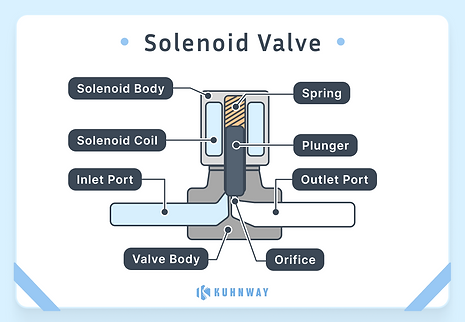
Solenoid valves are actuated valves controlled electrically by energizing a solenoid coil to create magnetic attraction, which then moves a plunger to open or close the valve. They offer rapid response times and are well-suited for automated systems.
However, they are typically used for smaller flow rates and may be sensitive to fluid impurities. Common solenoid valve applications include irrigation systems, pneumatic controls, and industrial processes where quick, reliable fluid control is needed. They can also be found in everyday appliances, like ice makers, and dishwashers.
-
Hydraulic-actuated Valve
Hydraulic-actuated valves are actuated valves that use pressurized hydraulic fluid, normally oil, to move the valve mechanism. This type of actuation functions similarly to pneumatic systems, using fluid pressure to generate thrust that drives the piston. They provide smooth, powerful operation and are suitable for controlling large valves in high-pressure and high-flow systems.
However, they require a hydraulic power source and regular maintenance. These valves are commonly used in heavy machinery, oil and gas industries, and marine applications, where robust and reliable operation is critical.
-
Pneumatically-actuated Valve
Pneumatically actuated valves rely on compressed air or gas as an external pressure source to drive a piston within a closed cylinder or diaphragm, enabling the valve to fully open or close. They offer quick, reliable control and are safe for hazardous environments since they don’t require electricity. They rely on a consistent air supply and need maintenance to prevent leaks. These valves are widely used in manufacturing, chemical processing, and automation systems for fast and frequent operations.
Comparison Chart for Different Types of Valves and Applications
Valve Type
Opening Methods
Pros
Cons
Applications
Gate Valve
Linear
Reliable, minimal pressure loss, durable
Not suitable for throttling, slow operation
Water supply, oil pipelines, industrial plants
Globe Valve
Linear
Precise flow control, excellent sealing
Higher pressure drop, expensive, bulky
Steam systems, cooling lines, fuel processes
Needle Valve
Linear
Highly precise, robust for low-flow systems
Not for high-flow systems, prone to clogging
Instrumentation, chemical dosing, lab experiments
Pinch Valve
Linear
Cost-effective, leak-resistant, ideal for abrasive fluids
Limited to tube material properties, not for high pressure
Mining, wastewater treatment, food processing
Diaphragm Valve
Linear
Handles corrosive fluids, clean, easy to maintain
Not suitable for high-pressure systems, diaphragm wear
Water treatment, pharmaceuticals, food industries
Ball Valve
Rotary
Fast operation, tight sealing, compact
Not ideal for throttling, harder to clean
Hydraulic systems, gas pipelines, high-pressure applications
Butterfly Valve
Rotary
Lightweight, cost-effective, quick operation
Limited throttling at high pressure differences
Large pipelines, HVAC systems, fire protection
Plug Valve
Rotary
Simple design, durable, handles various fluids
Large sizes need significant force, regular maintenance
Chemical processing, natural gas, oil refineries
Check Valve
Automatic
Prevents backflow, protects equipment, simple operation
Risk of water hammer, debris can affect sealing
Pump discharge lines, water systems, fuel pipelines
Pressure-Reducing Valve
Automatic
Stable pressure control, no external power needed
Pressure drops, requires maintenance
Water distribution, industrial setups, irrigation
Pressure-Relief Valve
Automatic
Prevents overpressure, ensures safety
Limited fine control, needs regular inspection
Boilers, pressure vessels, piping systems
Pressure-Sustaining Valve
Automatic
Maintains critical upstream pressure
Incorrect settings can affect downstream pressure
Water systems, industrial processes
Motor Valve
Actuated
Precise and reliable, suitable for automation
Dependent on electricity, complex installation
HVAC systems, industrial automation, process control
Solenoid Valve
Actuated
Fast response, versatile, ideal for automation
Sensitive to impurities, limited flow rates
Irrigation, pneumatic controls, industrial processes
Hydraulic-Actuated Valve
Actuated
Powerful, smooth operation for high-pressure systems
Requires hydraulic power source, regular maintenance
Heavy machinery, oil and gas, marine applications
Pneumatically Actuated Valve
Actuated
Quick control, safe for hazardous environments
Requires consistent air supply, potential for leaks
Manufacturing, chemical processing, automation systems
.
.
Other Common Valves Classification
In addition to motion and actuation methods, valves are commonly classified based on pressure and temperature ratings, end connection types, and body materials.
-
Pressure and Temperature Ratings
Valves are engineered to operate safely and efficiently within specific pressure and temperature ranges.
Pressure ratings, as standardized by ASME B16.34, define the maximum allowable working pressure (MAWP) for various materials at specific temperatures. These ratings are categorized into classes like 150, 300, 600, 900, and beyond, ensuring compatibility with system requirements. Temperature ratings depend heavily on valve materials as this is also regulated by the ASME standard.
For example, a Class 150 valve made from ASTM A216 WCB carbon steel can handle pressures up to 285 psi at 100°F, with allowable pressure decreasing as temperature increases. Conversely, a Class 1500 valve of the same material can withstand pressures up to 3,750 psi at 100°F. This classification system ensures that valves are selected appropriately for their intended pressure and temperature conditions, maintaining safety and efficiency in piping systems.
Here are some common valves:
-
Low-Pressure Valves: These valves are typically designed for systems operating at pressures up to 1.6 MPa (approximately 232 psi). They are commonly used in applications such as residential plumbing, water treatment, and irrigation systems, where the pressure requirements are relatively modest.
-
High-Pressure Valves: High-pressure valves are engineered to withstand significantly higher pressures, often exceeding 10 MPa (about 1,450 psi). They are essential in industries like oil and gas and chemical processing, where systems operate under environments with extreme pressure.
-
Cryogenic Valves: Designed for extremely low temperatures (below -238°F), cryogenic valves are used in applications involving liquefied gases, such as liquid nitrogen, ensuring proper sealing and operation at sub-zero temperatures.
-
High-Temperature Valves: These valves can operate in environments with temperatures exceeding 1000°F, making them suitable for steam services and power generation facilities.
-
End Connection
The way a valve connects to a piping system impacts its installation, maintenance, and suitability for specific applications. Here’s an overview of common end connection types:
-
Flanged End Valves: Flanged valves have protruding flanges that bolt directly to the pipe flanges, forming a strong, leak-proof connection. They are easy to install, remove, and maintain, making them ideal for high-pressure or large-diameter pipelines. These valves are commonly found in water distribution and industrial systems.
-
Threaded End Valves: Threaded valves feature internal or external screw-threaded ends that connect directly to threaded pipes. They are perfect for smaller pipe sizes, low-pressure systems, and temporary installations. Their simplicity makes them common in residential plumbing and irrigation setups.
-
Welded End Valves: These valves are welded permanently into the piping system, creating a seamless, leak-free joint. Welded valves are best suited for high-pressure, high-temperature applications where reliability and durability are critical, such as in oil and gas pipelines.
-
Clamped Valves: Clamped valves use clamps to secure the valve to the piping system. This design allows for quick assembly and disassembly, making them a preferred choice in sanitary industries like food processing and pharmaceuticals, where regular cleaning is essential.
-
Wafer Valves: Wafer-style valves fit between pipe flanges and are secured with bolts passing through the flanges. They are compact, lightweight, and cost-effective, making them suitable for applications with space constraints, such as HVAC systems and water pipelines.
-
Body Material
The material composition of valve bodies is crucial, as it directly impacts their durability, compatibility with various fluids, and performance under different operating conditions. Choosing the wrong material can lead to corrosion, leaks, or even system failure. Here are some common materials used in valve construction:
Metallic Valves
-
Carbon Steel: Valves made from carbon steel are widely used due to their strength and ability to withstand high pressures and temperatures. They are suitable for standard services and are commonly used in industrial applications.
-
Stainless Steel: Types like 304 and 316 stainless steel offer excellent corrosion resistance, making them ideal for applications involving corrosive media. 316 stainless steel, in particular, contains molybdenum, enhancing its resistance to pitting in chloride-containing solutions.
-
Cast Iron and Ductile Iron: These materials are typically used for low to medium-pressure applications. Cast iron is suitable for temperatures between -15°C to +200°C, while ductile iron can handle temperatures from -30°C to +350°C.
-
Brass: Known for their good corrosion resistance and excellent machinability, making them suitable for various applications. However, they are susceptible to de-zincification in specific environments. It is also a popular choice for low-pressure systems due to its durability and ease of manufacturing.
-
Copper: Offers excellent thermal conductivity, corrosion resistance, and ductility, making it ideal for high-temperature fittings joined by soldering or brazing in chemical and water systems.
-
Bronze: Stronger than copper, bronze resists pitting corrosion, and is easily cast and machined, making it a standard for pressure-rated valves in industrial and chemical applications.
Non-Metallic Valves
-
PVC (Polyvinyl Chloride): PVC valves are lightweight, cost-effective, and exhibit excellent corrosion resistance, making them suitable for chemical processing and water treatment applications. They are generally used in low-pressure and low-temperature settings.
-
PTFE (Polytetrafluoroethylene): Known for its high chemical resistance and non-reactivity, PTFE is used in applications involving highly corrosive fluids. It also has a wide temperature tolerance, enhancing its versatility.
Alloy Valves
-
Inconel: This nickel-chromium-based alloy offers exceptional resistance to oxidation and corrosion at high temperatures, making it suitable for extreme environments like power generation and chemical processing.
-
Hastelloy: Known for its outstanding resistance to a wide range of chemical processes, Hastelloy valves are indispensable in industries dealing with highly corrosive substances, such as pharmaceuticals and petrochemicals.
How to Select the Right Type of Valve: What Else to Consider
We’ve covered valve classifications based on opening methods, pressure ratings, temperature ranges, materials, and connection types, all of which are critical to finding the right fit for your system. But beyond these basics, there are other important considerations. Let’s dive into these factors to help you make the best choice for your needs.
First, determine the valve's role in regulating flow, whether it is used for on/off control, throttling, or preventing backflow. For precise control over flow rates or positions, control valves equipped with positioners or modulating actuators offer fine-tuned control over process variables, ideal for applications with stringent performance requirements. For quick on/off operation, ball or butterfly valves are excellent choices. If preventing backflow is the priority, use a check valve.
The sizing for valves is also important. Considering both the physical dimensions and internal flow rates to ensure a proper fit and accurate flow control. A valve that’s too small can restrict flow and cause upstream back-pressure, while an oversized valve reduces flow control precision. It is best to match the connector diameter and flow rate to your system needs.
The media being controlled—whether liquid, gas, slurry, or corrosive chemicals—affects valve selection as well. For example, pinch valves are ideal for slurries, while solenoid valves are excellent for automated control of gases and liquids in irrigation or industrial systems. Naturally, this affects the materials for valves, for example, when monitoring harsh or corrosive materials, materials like PTFE and PFA are suitable due to their ability to withstand such conditions.
Finally, balancing cost and quality is just as crucial. While it may be tempting to focus on lower initial costs, investing in high-quality valves can significantly reduce long-term expenses, such as replacements. Also, consider the maintenance requirements—valves with simpler, reliable designs are easier to service, be cleaned regularly, and help reduce downtime and operational costs. Thoughtful selection not only enhances efficiency but also extends the valve's lifespan, offering better value over time.
FAQs
-
What are the main types of valves?
Valves are mainly grouped into linear motion, rotary motion, automatic, and actuated types. Linear valves include gate and globe valves. Rotary valves include ball and butterfly valves. Automatic valves respond to pressure changes, while actuated valves use electric, pneumatic, or hydraulic power.
-
What is the difference between manual and actuated valves?
Manual valves are operated by hand using levers or handwheels, and self-actuated valves respond to system pressure without external power. Actuated valves rely on electric, pneumatic, or hydraulic actuators. They allow remote control, automation, faster operation, and better precision in complex systems.
-
What are the differences between linear valves and rotary valves?
Linear valves move their closure element in a straight line and are often multi-turn, offering precise flow control. Rotary valves use a rotating component and are usually quarter-turn, allowing faster operation. Linear valves are better for modulation, while rotary valves are ideal for quick shut-off.
-
What are the common classifications of valves?
Valves are classified by operation mode, pressure and temperature rating, end connection type, and body material. Standards like ASME B16.34 define pressure classes. Valves may be flanged, threaded, or welded, and made from metallic, non-metallic, or alloy materials.
-
Can all linear valves be used as control valves?
No, not all linear valves are suitable for control applications. Gate valves are designed for full open or full closed service and can be damaged if used for throttling. Globe and needle valves, however, are specifically built for precise flow regulation.
-
What are the common materials used for making valves?
Common valve materials include carbon steel, stainless steel, cast iron, brass, and bronze. Non-metallic options like PVC and PTFE provide corrosion resistance. High-performance alloys such as Inconel and Hastelloy are used in extreme temperature or highly corrosive environments.
Kuhnway: Elevate Your Operations with Superior Valves
Valves are essential components that keep countless systems running smoothly, from industrial plants to everyday plumbing. We've explored the various kinds of valves in piping, classifications, and their unique applications, showing how each one plays a critical role in controlling and optimizing fluid flow.
Understanding their features and selecting the right type ensures system efficiency, safety, and reliability. With this knowledge, you can make confident project choices and achieve the best possible results. Of course, you will always need an experienced valve supplier for high-quality products, reliable performance, and expert guidance to ensure your systems operate efficiently and effectively.
At KUHNWAY Corporation, we understand that selecting the right valve is crucial for achieving efficiency, safety, and reliability in your systems. Whether it's a 2-way solenoid valve for precise automation or an electric actuator for seamless operation, we've highlighted the wide range of valve types and their unique roles to guide you in making informed choices.
We take pride in our decades of expertise and innovation, ensuring that every product we deliver meets the highest standards of quality and performance. As you've learned about the diverse classifications and applications of valves, we’re here to provide the solutions that best fit your needs.
Let KUHNWAY be your trusted valve manufacturer in powering your projects with the most advanced and reliable valves on the market. Contact us today, and let’s work together to achieve excellence in every system you build. Your success is our commitment!
Master 15+ Types of Valves: Functions, Industrial Uses, and More
Understand the different types of valves, their common uses, and internal mechanisms. Learn how to choose the precise valve for any industrial application.